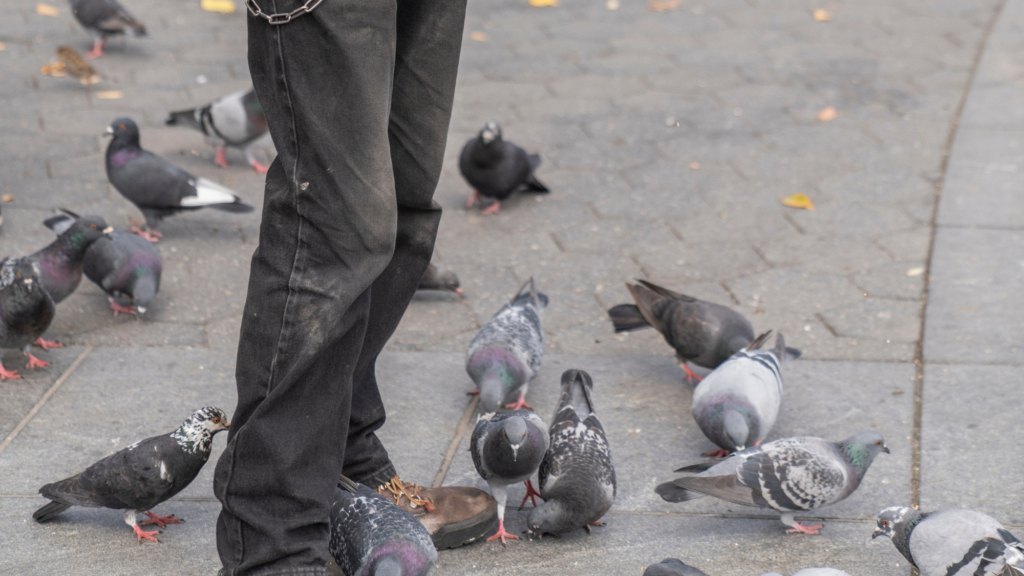

We tend to think of Darwinian survival as only applicable to wild animals in wild environments, such as jungles. But why can’t it just as easily apply to animals living in big cities?
Spend enough time in a major city and you’ll notice that animals stop behaving with their natural animal instincts and instead start behaving like opportunists, feeding on trash they find lying around. Almost every animal that lives in the city is transformed into its own version of Pizza Rat, the once virally famous rat that was seen dragging a giant slice of pizza along a New York City sidewalk.
And not just the opportunistic rats. It’s birds, it’s monkeys, it’s squirrels.
According to an essay by researchers Daniel T. Blumstein, Peter Mikula and Piotr Tryjanowski, it’s part of a broader shift called “behavioral homogenization.” All over the planet, urbanized animals began to behave the same, even though they are completely different species living on completely different continents, because cities, no matter where you go and no matter how different their cultures make them, they are all fundamentally the same.
Animals that call them home are often adaptable and willing to stick much closer to humans as a means of survival, feeding on our waste.
Animals in human cities start behaving very strangely. Here’s why.
These animals tend to be bolder and riskier; they learned behaviors and survival tactics that their wild brethren never would. A wild animal will never learn to open a garbage can lid or remember human routines so they can be in a certain place at a certain time because they know there will be food there. Cities created an entirely new, specific type of less fearful, more opportunistic, and increasingly human-dependent animals.
The three researchers argue that we are even seeing how urban life affects the way these animals communicate with each other, with urban birds starting to sound more alike because urban noise forces them to sing louder to be heard over the din of human bustle and to sing earlier and at higher frequencies. It’s development happening in real time, and right around the block from our apartments.
It’s a fascinating development, but one that reduces diversity both between and within species, the trio argue. All this uniformity leads to less genetic flexibility, making animals more vulnerable to future environmental changes. It also changes learned behaviors that have been ingrained in these animals over thousands of years, such as tree routes and feeding strategies, that don’t seem particularly useful in a larger city of relative abundance.
It all looks like a lot of animals cleverly adapting to their human-dominated environment, but it’s really slipping away from diversity and simplifying animal populations to the point where it may one day become an obstacle to their own survival.